
Understanding the Water Quality Factors That Matter in Commercial Water Filtration
Water is one of those everyday resources that businesses tend to notice only when something goes wrong. A restaurant suddenly has strange-tasting ice. A hotel starts seeing mineral spots on bathroom fixtures. A commercial kitchen finds itself cleaning equipment more often than usual. These problems can seem unrelated, but sometimes they have the same starting point: the water entering the building.
Commercial water filtration isn’t simply about making water look cleaner. Different properties have different water conditions, and the right filtration approach depends on what’s actually present. Understanding common concerns such as disinfectants, suspended particles, and naturally occurring minerals can make treatment decisions much more practical.
Why Water Quality Matters in Commercial Operations
Commercial facilities often use large amounts of water every day. Restaurants need it for cooking, cleaning, beverages, and ice. Hotels use water throughout guest rooms, kitchens, laundry areas, and maintenance systems. Offices and other facilities may have less intensive demand, but water still supports many everyday activities.
Because usage can be high, even a relatively small water-quality concern may become noticeable over time. Sediment can affect filters and valves, mineral deposits can build up inside equipment, and certain compounds can influence taste or odor.
The first step is understanding the water rather than immediately purchasing treatment equipment.
The Role of Chlorine and Chloramines
Municipal water supplies are commonly disinfected before reaching customers. Depending on the local water provider, chlorine or chloramine-based treatment may be used as part of that process.
These disinfectants serve an important purpose, but some businesses may notice their effects on taste and odor. This can be particularly relevant in restaurants, cafés, hotels, and other places where water becomes part of a customer’s experience.
Chlorine and chloramines can also influence the choice of filtration media. Certain carbon filters are designed to reduce specific disinfectants, but their performance depends on the filter design, contact time, water chemistry, and operating conditions.
Testing is therefore useful before deciding what type of filtration is necessary.
What Sediment and Turbidity Tell You
Water can contain suspended particles that aren’t always obvious when you first turn on a faucet. These particles may come from the source water, distribution system, or building plumbing.
Sediment and turbidity are related to suspended material in water, although they describe different things. Sediment generally refers to particles that can settle or be filtered, while turbidity describes how cloudy or hazy water appears because of suspended matter.
In a commercial setting, excessive particles can create practical problems. They may collect inside filters, valves, fixtures, and water-using equipment.
A properly selected sediment filter can help reduce these particles, but filter selection should consider particle size, flow rate, capacity, and the actual level of contamination.
Why Iron and Sulfur Can Become Noticeable
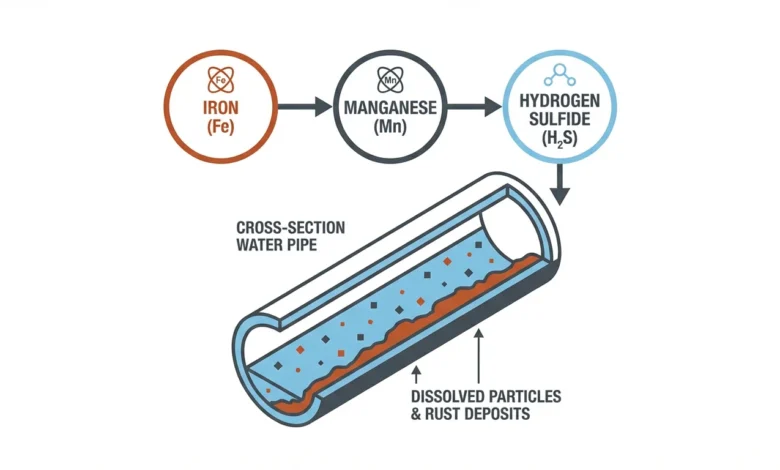
Some commercial properties, especially those using private wells, may experience concerns involving iron and sulfur.
Iron can leave reddish, orange, or brown staining on fixtures and laundry. Sulfur compounds may create an unpleasant rotten-egg-like odor. These issues can be especially frustrating for businesses where customers directly experience the water.
The solution depends on the concentration and chemical form involved. Different treatment technologies are designed for different conditions, so simply installing a general-purpose filter may not solve the problem.
A water test can help identify what is actually happening and prevent unnecessary equipment purchases.
How Water Chemistry Affects Equipment
Commercial water-using equipment can be sensitive to changes in water chemistry. Ice machines, coffee makers, dishwashers, boilers, water heaters, and laundry systems all interact with the water supply.
Hardness minerals may contribute to scale. Sediment can interfere with valves and filters. Certain water conditions can also contribute to corrosion over time.
These problems don’t always happen suddenly. Often, equipment continues working while gradually becoming less efficient or requiring more frequent cleaning.
That makes preventive water management worthwhile, especially when a business depends on expensive equipment every day.
Choosing Filtration Based on the Actual Problem
There isn’t one filtration system that can solve every water-quality issue. That’s why testing should ideally come before choosing equipment.
If suspended particles are the main concern, sediment filtration may be appropriate. If certain tastes, odors, or disinfectants are present, carbon filtration could be considered. Hardness may require softening, while other dissolved substances may require specialized treatment.
The objective isn’t to install the most complicated system available. It’s to address the problem that actually exists.
A properly matched system is often more useful — and less expensive to maintain — than an oversized setup with features a business never needs.
Considering Flow Rate and Capacity
Commercial filtration has to keep up with real-world water demand. This is particularly important in busy facilities where several fixtures or appliances may operate at the same time.
A restaurant, for example, may have peak water demand during lunch and dinner service. A hotel can experience significant usage in the morning when many guests shower and use bathrooms simultaneously.
Businesses should therefore consider both average consumption and peak flow when selecting filtration equipment.
A filter that is too small may restrict flow or require frequent replacement. A system that’s far larger than necessary can increase the initial investment without providing meaningful additional value.
Maintenance Is Part of the Solution
Installing a filtration system doesn’t mean water management is finished. Filters have service lives, and components need periodic inspection.
Businesses should maintain records of filter replacement dates, water-testing results, inspections, and unusual changes in pressure, taste, odor, or equipment performance.
This kind of record keeping may sound mundane, but it can make troubleshooting much easier. If water flow suddenly decreases, for instance, maintenance records can help determine whether a filter is approaching the end of its useful life.
Why Testing Can Save Money
Water testing isn’t only about identifying problems. It can also prevent businesses from spending money on unnecessary treatment.
If a business assumes hardness is the issue and purchases a softener without testing, it may discover later that sediment or another characteristic was responsible for the original concern.
Testing provides a more reliable starting point. It allows businesses to compare treatment options based on actual water conditions rather than marketing claims or assumptions.
A More Practical Approach to Commercial Water Treatment
Good commercial water management is less about buying the biggest filtration system and more about making informed decisions.
Start by testing the water and identifying the characteristics that matter for the property. Consider how the water is being used, which equipment depends on it, and what problems have already appeared.
Then choose filtration that matches those needs and maintain it consistently.
Water will always be part of commercial operations. The goal isn’t to make it complicated. It’s to understand it well enough to protect equipment, support daily operations, and provide a better experience for the people who depend on the business.
A thoughtful approach — test, understand, treat, and maintain — can go a surprisingly long way.